Communication strategy: UFO museum brand
Contents:
• The role of communication theory in visual design • Presentation for a general audience • Presentation for a professional audience • Theory behind the project
The role of communication theory in visual design
Graphic design is a form of visual communication that conveys meaning through images, color, composition, and typography. Communication theory helps us understand why some visual solutions are perceived as clear and persuasive, while others are not. First, graphic design is closely connected to rhetoric. Any poster, logo, or advertising layout aims to influence the viewer: to attract attention, evoke emotion, and shape an attitude. The Elaboration Likelihood Model (ELM) shows that people process visual messages differently—either thoughtfully or superficially. Therefore, design must be both informative and emotionally expressive. Second, graphic design is rooted in semiotics—the study of signs. Colors, shapes, and typefaces carry cultural meanings and evoke stable associations. Designers rely on these codes so the viewer can grasp meaning quickly and without additional explanation. Graphic design always operates within a sociocultural context. Styles, visual symbols, and compositional choices do not appear in isolation; they are shaped by culture and, in turn, shape it. Through visual language, brands construct their identities and influence audience expectations. The list could go on endlessly, but the essential point remains the same: a design succeeds not only when it is beautiful, but when it is understandable. Through associations, symbols, gestures, contexts, and cultural traditions, a comprehensive system is formed—one that allows a brand and its identity to emerge.
Presentation for a general audience
Who We Are?
We are an immersive cultural museum dedicated to the exploration of UFO phenomena and the idea of extraterrestrial life as a cultural, symbolic, and communicative subject. Our museum does not function as a scientific authority and does not claim factual truth. Instead, we create an experiential environment where visitors encounter ambiguity, alternative narratives, and open questions. We position ourselves as a space for interpretation rather than explanation. Through exhibits, installations, and visual storytelling, we invite visitors to reflect on how beliefs are formed, how myths emerge, and how humans respond to uncertainty. Our role is not to provide answers, but to create conditions for personal meaning-making.
Who the Brand Is For?
The brand is designed for young adults aged 20–30 who are culturally curious, media-literate, and open to unconventional experiences. Our audience includes students, creatives, early-career professionals, and individuals who seek alternative forms of leisure beyond traditional museums and entertainment. This audience is not defined by belief in UFOs. Rather, it includes people who are interested in questioning dominant narratives, exploring ambiguity, and engaging with speculative ideas without the pressure of accepting them as truth. They value experiences that stimulate reflection, identity exploration, and emotional engagement, and they are drawn to spaces that allow multiple interpretations instead of enforcing a single viewpoint.
Brand Message
We do not tell you what to believe. We invite you to question, observe, and interpret. UFO — Uncertain Forms of Truth We do not claim certainty, evidence, or final answers. Instead, we explore how truth is constructed, questioned, and reshaped through perception, belief, and doubt. UFO exists at the intersection of curiosity and skepticism, where multiple versions of reality coexist without competing for dominance.Uncertain Forms of Truth means accepting ambiguity as a value. It is the recognition that truth is not always singular, stable, or authoritative. It shifts depending on context, experience, culture, and the observer. Our museum invites visitors to step into this uncertainty. To observe without rushing to conclusions. To question narratives rather than replace one belief with another. To reflect on how meaning is formed — not only in relation to extraterrestrial life, but to the way humans search for explanations in an unpredictable world. UFO is a dialogue, not a declaration. An experience, not an instruction. A mirror for thought, not an answer. Here, truth does not arrive fully formed. It emerges — fragmented, personal, and open.


Brand Values
• Ambiguity — we value open-ended narratives and resist definitive answers. • Interpretation — we prioritize personal meaning-making over factual instruction. • Reflection — we encourage visitors to think not only about UFOs, but about belief, doubt, and human curiosity itself. • Dialogue — we support multiple viewpoints and the coexistence of skepticism and imagination. • Unconventional Experience — we offer non-standard cultural entertainment that combines curiosity, play, and philosophical depth.
Presentation for a professional audience
Brand platform and communication focus UFO is a conceptual museum that works with uncertainty, perception, and interpretation. The project explores how people assign meaning to unclear visual signals and how communication shapes our understanding of reality. The brand identity is built around a key idea: meaning is not fixed — it is created through the interaction between message, context, and the viewer.
Semiotic tradition
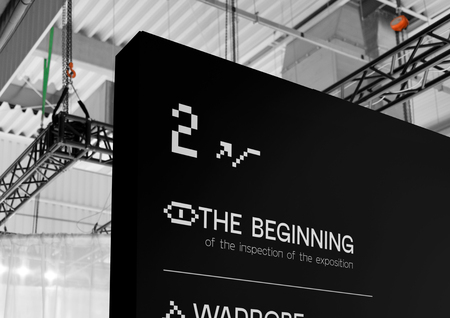
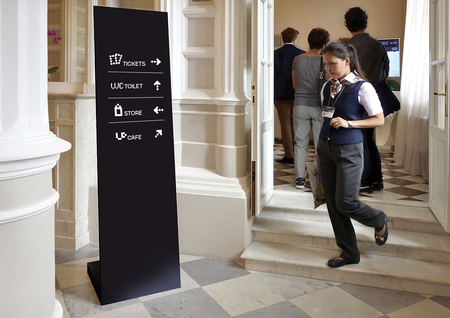
Within the semiotic tradition, the brand uses both color and form as visual codes. The deep black background functions as a cultural code for the unknown, emptiness, and cosmic space. Purple and blue glitch tones signal digital noise, night-vision technology, and low-quality UFO imagery. White modular typography represents clarity breaking through distortion. The graphics support the same logic. Pixelation, visual noise, and low resolution reference the typical look of UFO content online. Close-up zooms of unclear objects show how a neutral shape can become a «UFO» through interpretation. The logo [UFO] uses brackets as a semiotic marker: the word becomes a label rather than a statement, emphasizing ambiguity and uncertainty. Together, these elements illustrate how meaning is constructed through cultural codes rather than direct representation.
Socio-psychological tradition
The socio-psychological tradition focuses on how people notice, process, and react to messages. In this project, unclear and ambiguous visuals make viewers naturally try to understand what they are seeing. When the image doesn’t give enough information, people start to complete it in their minds — this is a common psychological reaction. Because the brand avoids direct statements and leaves space for interpretation, the viewer becomes more involved in the meaning-making process. Emotions like curiosity or slight confusion help shape their attitude toward the topic. This is exactly what the socio-psychological approach describes: communication influences us not only through clear messages, but also through the way we emotionally and cognitively respond to what we see.Sociocultural tradition
The sociocultural tradition views communication as a process that shapes shared norms and practices. In the project, the visual language is directly influenced by online communities: blurry UFO footage, digital artifacts, and conspiracy-style visuals. These elements reflect collective cultural practices of interpreting uncertain media.
Critical tradition
The critical tradition deals with how media can shape beliefs and reinforce certain ideologies. In the context of this project, low-quality visuals become a way to show how easily information can be manipulated or framed in a specific way. Media often uses uncertainty to create dramatic or emotional stories, and our design reflects this idea. The glitch aesthetic visualizes how truth can be distorted, the bracketed logo questions the authority of images, and the slogan «THEY ARE REAL» shows how certainty can be constructed.


Verbal strategy and rhetoric
The verbal strategy uses open and ambiguous phrases, giving the audience freedom to interpret the message. This approach fits well with rhetorical theory.
Aristotelian rhetoric: • Logos: the museum shows images and materials without forcing a conclusion, so the viewer can analyze them independently. • Ethos: the clean typography, minimalism, and structured design help build trust and make the brand look reliable. • Pathos: the emotional tone is connected to mystery and curiosity, which encourages the viewer to explore further.
Digital rhetoric:
In digital media, glitch effects and visual noise work as persuasive tools simply because they are fast, noticeable, and visually unusual. They catch attention and make the viewer pause for a moment — this small disruption creates enough interest to look closer and think about what they are seeing.
Theory behind the project
This project is built directly on the theories and approaches discussed in the online course on communication. In the course, communication is defined as a process of creating meaning through interaction and symbolic exchange within a specific context. We applied this idea to visual design: instead of treating design as decoration, we treated it as a system of messages where meaning is co-created by the brand, the medium, and the viewer. Craig’s model of communication traditions was one of the main frameworks. We used it not as an abstract theory, but as a set of «lenses» to design and then analyze the brand. The semiotic tradition guided our work with signs and codes: dark colors, glitches, bracketed typography, and low-resolution imagery were chosen as visual signs that refer to mystery, unreliable media, and ambiguity. The socio-psychological tradition helped us think about attention, perception, and attitude formation. Ambiguous visuals and open messages were used on purpose to make viewers actively process what they see instead of passively consuming information.
The sociocultural tradition from the course was important for understanding UFOs not as isolated objects, but as part of shared cultural practices. The project borrows visual language from online communities, conspiracy aesthetics, and internet folklore. The critical tradition shaped the more reflective layer of the project. The course explains how media can support ideology and power structures. We translated this into design by showing how low-quality images, dramatic slogans, and glitch aesthetics can construct a sense of «truth» and emotional urgency, instead of simply reflecting reality.
Rhetorical theory from the course also played a key role, especially in separating the general and professional presentations. For the general audience, we relied more on pathos and accessible ethos: simple sentences, emotional appeal to curiosity and mystery, and a clear brand voice that invites interpretation rather than pushes conclusions. For the professional audience, we shifted closer to logos: we explicitly referenced semiotic, socio-psychological, sociocultural, and critical perspectives, and described how each of them is embedded in the visual system.
The Elaboration Likelihood Model (ELM) also influenced our structure. The general-audience text works more on the peripheral route: tone of voice, atmosphere, and emotional framing are central. The professional text is designed for central processing: it speaks to readers who are ready to think about theory, frameworks, and conceptual decisions in depth. In both cases, we use the same brand, but we change how we communicate it depending on how people are likely to process the message. Finally, the course distinguishes between theory as an abstract system and theory as a «lens» for practice. In this project, we used communication theory exactly in this practical way. It helped us decide which messages to leave open, how much ambiguity to keep, how to construct trust through visual language, and how to design a brand that does not «deliver truth» but stages a process of meaning-making. Both presentations — for a general audience and for a professional audience — are different expressions of the same theoretical base, showing how ideas from the course can be translated into concrete visual and verbal decisions in design.
Yang C.-M., Hsu T.-F. Applying Semiotic Theories to Graphic Design Education: An Empirical Study on Poster Design Teaching / Chao-Ming Yang, Tzu-Fan Hsu // International Education Studies. — 2015. — Vol. 8, no. 12. — P. 117-129. — Режим доступа: https://www.researchgate.net/publication/284791277_Applying_Semiotic_Theories_to_Graphic_Design_Education_An_Empirical_Study_on_Poster_Design_Teaching (дата обращения: 11.12.2025). (ccsenet.org)
Costa C. J., Aparicio M., Braga A. S. Design of Communication: A Review of Theories and Models / Carlos J. Costa, Manuela Aparicio, Andrew Simoes Braga // Proceedings of the Workshop on Information Systems and Design of Communication (ISDOC’12). — June 2012. — Режим доступа: https://www.researchgate.net/publication/232659003_Design_of_communication_A_review_of_theories_and_models (accessed: 11.12.2025). (ResearchGate)
Phare D. M., Gu N., Ostwald M. Representation in Design Communication: Meaning-Making in a Collective Context // Frontiers in Built Environment. — 2018. — Vol. 4. — Art. 36. — Режим доступа: https://www.frontiersin.org/journals/built-environment/articles/10.3389/fbuil.2018.00036/full (accessed: 11.12.2025)
Semiotics and Professional Graphic Design. — Режим доступа: https://www.academia.edu/494437/Semiotics_and_Professional_Graphic_Design (дата обращения: 11.12.2025). (Academia)
Griffin E. A First Look at Communication Theory: textbook. — 6th ed. — Boston: McGraw-Hill, 2006. — 563 p. — Режим доступа: https://cdn.bookey.app/files/pdf/book/en/a-first-look-at-communication-theory.pdf (accessed: 10.12.2025)
Saputra M. Theories and Models of Communication. — Berlin; Boston: De Gruyter, 2013. — 453 p. — Режим доступа: https://www.academia.edu/42885683/Theories_and_Models_of_Communication (accessed: 09.12.2025)
https://portfolio.hse.ru/Project/177861 (accessed 14.12.2025)
https://worldbranddesign.com/ufo-brand-identity-by-novikova-sofya/ (accessed 14.12.2025)