Brand presentation: ALTERNATIVE
ALTERNATIVE
Modern Art Biographies as a Game

Contents
1. Theory: how communication works in design 2. Brand presentation for a general audience 3. Brand presentation for a professional audience 4. How course Communication Theory became the foundation of this project 5. Bibliography + image sources
1.1 Theory: how communication works in design
Communication theory works as a decision tool in design
Communication theory matters in design because it turns intuition into a structured way of thinking.
It provides: - shared terms and definitions (so we can name what we design), - a lens/framework (so we can focus in complexity), - a systematic summary (so we can generalize patterns).
In practice, theory helps us describe → explain → predict → transform communication outcomes.
What communication theory helps designers control
Design communicates because meaning is encoded into form and later decoded by audiences. Theory helps us manage what typically breaks communication:
- noise (overload, ambiguity, weak hierarchy, wrong channel), - context (culture, situation, prior knowledge), - feedback (responses that should reshape the next iteration).
This is why communication strategy is not «style» — it is managing interpretation over time.
Choosing a theory lens changes what «good design» means
Different theories highlight different parts of the same process (Craig’s traditions).
In design practice, we choose a lens based on what we need to solve:
- Semiotic → how signs/symbols communicate meaning in identity and UI. - Rhetorical → how structure and delivery persuade in presentations. - Cybernetic → how channels, noise, and feedback shape understanding over time. - Critical → how ideology/power/ethics affect what is «said» and what is «read».
What «communication strategy» means in design terms?
A communication strategy in design answers the same four questions in any project:
1. Who is the audience (and what motivates them)? 2. What meaning do we encode (values, promise, framing)? 3. How do we encode it (visual language, narrative, interaction)? 4. Where does meaning travel (channels, interpreters, platform filters)? 5. Theory is the tool that justifies these choices.
Audiences do not consume meaning passively. Meaning is negotiated through:
- cultural codes - prior knowledge - situation and motivation - trust in the source
So one message can produce multiple readings.
2. Brand presentation for a general audience
ALTERNATIVE is a game-like service that helps people learn modern art through artist biographies.
You don’t memorize dates. You experience turning points.
The Problem → Our decision
Modern art often feels distant and «too academic.» Too many names and dates — hard to remember.
ALTERNATIVE makes it personal: experience the life behind the art through choices and consequences.
Why a Game?
Stories make learning stick.
A biography becomes memorable when you: - follow conflict - make a decision - see what it changes - reflect on meaning
3. Brand presentation for a professional audience
Professional Overview. ALTERNATIVE as a product system
ALTERNATIVE is an edutainment platform built from four layers:
- Narrative engine: biographies as playable story routes - Interaction design: dilemmas, choices, consequences - Curated content: artworks + context cards (sources-based) - Community layer: discussion prompts + moderation
Design goal: make modern art learning feel clear, humane, and non-academic without losing credibility.
Design goal: make modern art learning feel clear, humane, and non-academic without losing credibility.
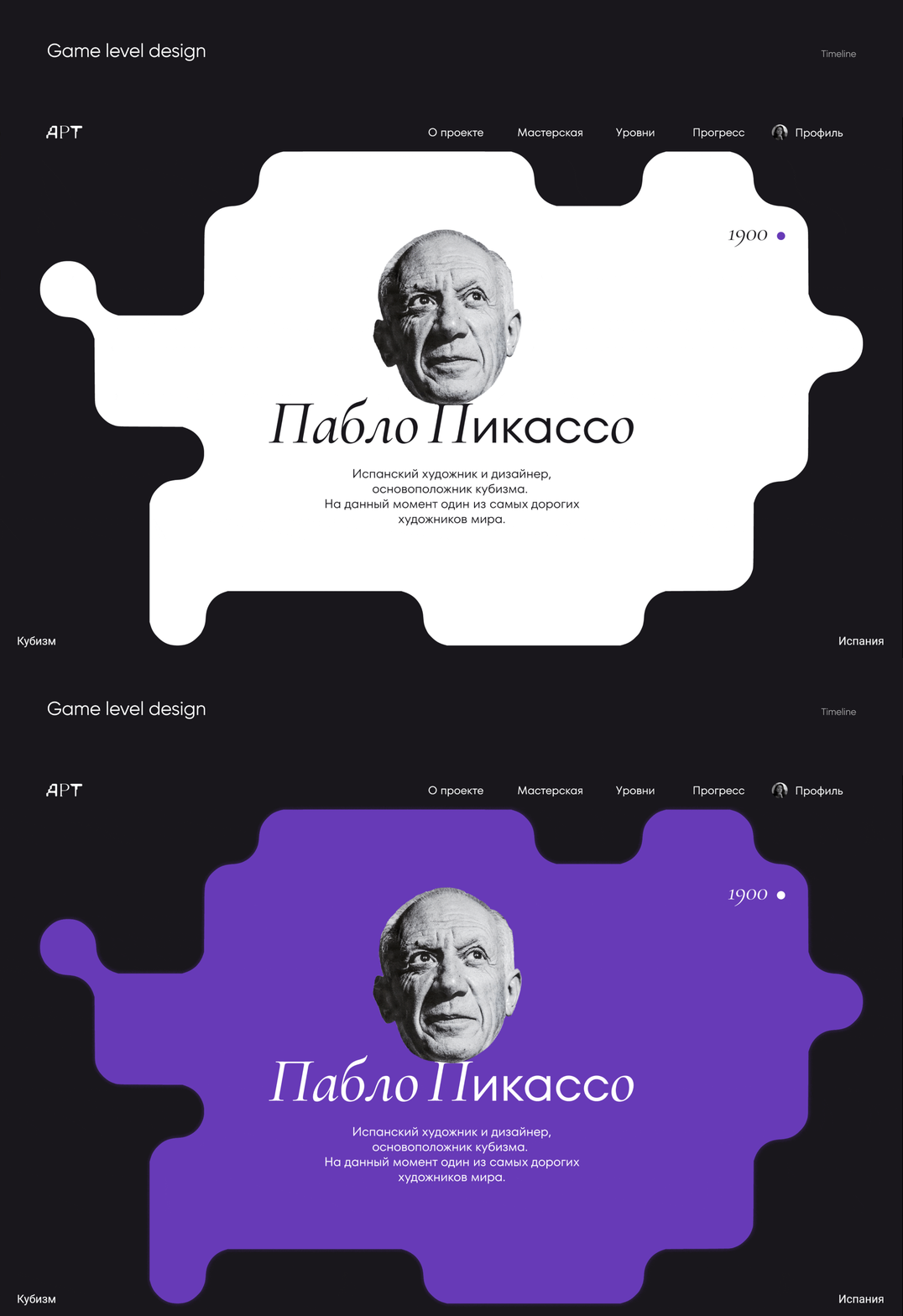
Core metaphor: puzzle = understanding
- The biography puzzle as a learning metaphor - Learning is framed as assembling a whole picture from fragments - «Pieces» = turning points, relationships, artworks, context - Completion = understanding the artist beyond dates and trivia - Metaphor supports motivation, pacing, and retention
Identity system

Product architecture
Game loop and user journey
- Pick an artist route - Play short episodes (5–8 min) - Unlock artworks and context as «evidence» - Complete the biography puzzle - Share / discuss a turning point
4. How course Communication Theory became the foundation of this project
4.1. Our strategy was theory-driven
We did not start with visuals.
We started with communication theory and asked:
«What meaning do we encode, through which channels, for which audiences, and how do we learn from feedback?»We use course frameworks as a decision system for:
(1) our reasoning about design communication, and (2) our brand communication for general and professional audiences.
The method
We did not treat theory as definitions to repeat.
We treated theory as a tool to make decisions: Framework → Question → Decision → Artifact (slides) → Expected decoding
Link to Part 1 (author’s reasoning)
How theory shaped our reasoning about design
Course theory gives us lenses to argue that design works as: - meaning encoded in signs - meaning decoded in context - meaning stabilized through feedback and iteration
So Part 1 is built as an argument: theory explains how design produces interpretation.
Link to Part 2 (general audience section)
How theory shaped the general-audience brand story
We used course logic to choose: - simpler framing and minimal terminology - clear «what it is / why it matters» narrative - credibility cues without heavy proof
Goal: reduce effort and increase entry motivation (how audiences decode in low-effort mode).
Link to Part 3 (professional section)
How theory shaped the professional brand explanation
For professionals, the same meaning is communicated through:
- system logic (how the product works) - content architecture (what is produced) - rules and constraints (how credibility is protected)
Goal: support high-effort evaluation and make the concept implementable.
Conclusion
This project showed how communication theory can function as a practical design tool.
By using course frameworks as lenses, we translated abstract concepts into concrete decisions: how we frame meaning, how we structure a story, how we reduce noise, and how we choose channels.
As a result, ALTERNATIVE communicates one core idea through two audience-oriented sections—without losing clarity, credibility, or purpose.
Course lecture notes. Communication Theory: Bridging Academia and Practice. (n.d.). Course lecture notes (PDF provided in class).
Craig, R. T. (1999). Communication theory as a field. Communication Theory, 9(2), 119–161.
Petty, R. E., & Cacioppo, J. T. (1986). Communication and persuasion: Central and peripheral routes to attitude change. Springer.
Fisher, W. R. (1984). Narration as a human communication paradigm: The case of public moral argument. Communication Monographs, 51(1), 1–22.
Grunig, J. E., & Hunt, T. (1984). Managing public relations. Holt, Rinehart and Winston.