Deviant in Cinema and Painting
Deviant in Cinema and Painting
To call someone or something deviant is not just to say «bad» or «perverse»: it literally means «off the way» — from the Latin de (off) and via (road). Deviance is therefore always relational: it only appears once a norm has been drawn.Seen from this angle, art and cinema become laboratories of deviance. They stage figures who drift away from the socially accepted path, exposing the violence, hypocrisy or emptiness built into that path itself.
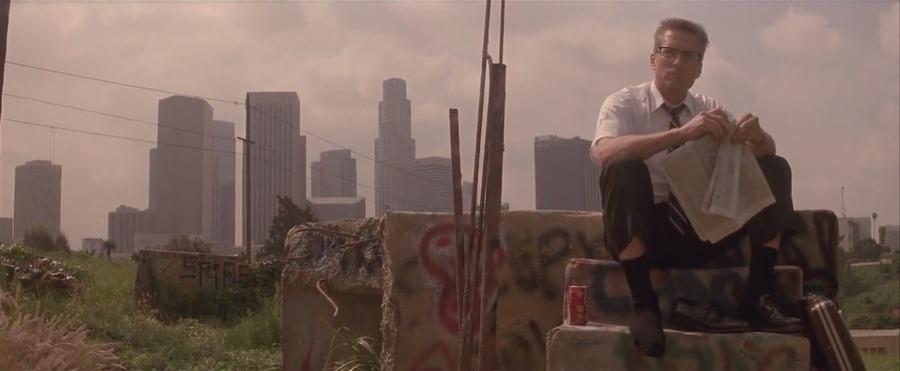
«Falling Down» (1993) by Joel Schumacher

In «Falling Down», Joel Schumacher follows William Foster, a recently laid-off defence worker in Los Angeles, who abandons his car during a traffic jam and starts walking across the city, becoming increasingly violent as minor frustrations accumulate.
On one level, Foster clearly functions as a deviant: he breaks laws, threatens strangers, and ultimately becomes a public danger. But the film constantly links his breakdown to structural pressures — deindustrialisation, economic precarity, urban segregation and the empty promise of middle-class stability.
Foster’s white-collar outfit and briefcase mark him as the embodiment of a certain «normal» American male. When this figure snaps, the film suggests, it is not simply because of individual madness but because the social script he was given no longer makes sense. His deviance exposes the latent aggression, racism and entitlement that were always coded into that script. He is «off the way», but the way itself — the ideal of the orderly, white, productive citizen — turns out to be deeply unstable.
«Taxi Driver» (1976) by Martin Scorsese
Two decades earlier, «Taxi Driver» had already explored a similar figure: Travis Bickle, an insomniac Vietnam veteran driving a taxi through a decaying New York. As he drifts through the city’s night-time economy of sex, drugs and petty crime, his disgust grows into a violent messianic fantasy.Travis is clearly deviant in the psychiatric sense — isolated, paranoid, hallucinating.
The film insists on his status as a veteran and worker: someone supposedly reintegrated into society, yet unable to find a «place» in its moral and economic order. His deviance is also a deviance of the city: a response to an environment that constantly bombards him with pornography, corruption and political cynicism. When he turns his violence against pimps and a would-be politician, the film raises an uncomfortable question: is this deviance or an extreme, distorted version of the vigilante fantasy promoted by the culture itself?
Compared with Foster in «Falling Down», Travis lacks the middle-class stability and family narrative; yet both characters embody a specifically masculine, white, Western idea of the subject that has lost its coordinates. Their deviance is not exotic or marginal — it’s the «normal» subject turning inside-out. In terms of the «deviant» definition, both films show deviancy as a movement away from the official path of the post-war American dream, revealing that path as violent and unsustainable.
«A Clockwork Orange» (1971) by Stanley Kubrick
If «Taxi Driver» and «Falling Down» focus on damaged adult men, «A Clockwork Orange» presents deviance as a youthful, almost playful energy that threatens to overflow the entire social order. Kubrick’s film follows Alex DeLarge, a charismatic teenage delinquent whose pleasures are «ultra-violence» and Beethoven.
He is deviant in several senses at once: criminal, sadistic, erotically transgressive, but also aesthetically «wrong» — his stylised costumes, invented slang and theatrical gestures mark him as out of sync with any stable identity.
What makes the film central for thinking about deviance is not just Alex’s behaviour but what the state does with it. After his arrest for murder, Alex is subjected to the Ludovico Technique, an experimental conditioning treatment that makes him physically incapable of violence by inducing extreme nausea in response to violent images and even to Beethoven. The state tries to erase deviance by rewiring his body and desires.
Here the deviant body becomes a battleground between individual freedom and state control. The question is no longer «Is Alex bad?» but «Is a society that removes free will in order to enforce normality more or less deviant than the criminals it disciplines?». The film pushes the «deviant» definition to an institutional level: the brutal experiment itself is a deviation from humanist principles, carried out in the name of order.
If Foster and Travis reveal the cracks in the normal citizen, Alex’s story reveals how far institutions are willing to go to police deviance — and how that policing can itself slide into a darker, more systemic form of deviant violence.
Egon Schiele
A Tree in Late Autumn, 1911
With Egon Schiele, deviance appears less in explicit narrative and more in the line itself. Even when we bracket his most sexually explicit works, his tree landscapes and portraits insistently deform and twist the body and the world.
Many of his tree paintings isolate a single autumnal tree in an empty field, with branches like painfully extended fingers. Instead of a harmonious, idealised nature, we get something closer to a wounded organism.
The same applies to his portraits.Hands are too large, faces are pale and hollow-eyed, bodies contort in uncomfortable poses. Even when the subject is simply sitting or standing, the pose feels slightly «wrong» — as if the sitter’s psychological tension has invaded their musculature. His line deviates from academic smoothness; it refuses the norm of the «beautiful body» and instead foregrounds nervousness, sickness, anxiety.
Portrait of Madame Dr. Horak, 1910
Hieronymus Bosch
The Garden of Earthly Delights, 1510 — 1515
If Schiele’s deviance is internal and psychological, Hieronymus Bosch stages deviance as an entire world turned upside down. His paintings are populated by hybrid monsters, grotesque punishments and chaotic scenes of folly and sin. Early art theorists already noted that Bosch’s paintings departed sharply from naturalistic representation, using bizarre forms to communicate moral and allegorical themes.
Bosch’s images were probably meant as moralising tools, warning viewers against vice. But their intense visual fascination complicates that moral message. As some scholars have argued, the piety of Bosch’s images coexists with a dangerous imaginative excess: the paintings function as sermons on folly and sin, yet their seductive weirdness «resists simple condemnation».
Haywain (detail), 1516
Conclusion
If we take seriously the definition of deviant as «veering off the entrenched path», then the interest of these works lies not in condemning deviation but in asking what that path is and who drew it.
Deviance, in this sense, is not a marginal subject for art but one of its central tools. By stepping «off the way», art allows us to see the way itself — its exclusions, its violence, its fragility — with new clarity.